For the millions of families who form the backbone of the Indian agricultural sector, the Pradhan Mantri Kisan Samman Nidhi (PM Kisan) scheme has become a cornerstone of financial stability. By providing annual financial aid of ₹6,000, the central government aims to supplement the income of landholding farmers, helping you manage the costs of raw materials, farming incidentals, and essential domestic expenses.
However, as we move into the 2026 cycle, the scheme is undergoing a significant evolution. As highlighted by the NITI Aayog, the initiative is transitioning from an era of “scale” to one of “precision and fidelity.” While the early years focused on onboarding as many farmers as possible, the current priority is uncompromising data quality. Ensuring that every record is accurate, complete, and current is no longer just a technical requirement—it is a national imperative to prevent fiscal leakage and ensure that the dividends of this digital journey reach those who need them most without delay.
UNDERSTANDING THE PM KISAN SCHEME
The PM Kisan scheme is a central sector initiative where 100% of the funding is provided by the Government of India. It represents a massive leap in Digital Public Infrastructure, ensuring that aid is not lost in bureaucratic layers.
The Benefit Structure
The financial assistance provided under the scheme is structured to provide steady support throughout the year. The total annual benefit of ₹6,000 is credited via Direct Benefit Transfer (DBT) directly into the bank accounts of beneficiaries in three equal instalments of ₹2,000 each.
Instalment Timeline
To align with the agricultural seasons and your financial needs, the payments are distributed across three distinct periods:
- 1st Instalment: April – July
- 2nd Instalment: August – November
- 3rd Instalment: December – March
The “Scale to Precision” Pivot
According to recent insights from the NITI Aayog Frontier Technology Hub, the scheme has successfully reached an unprecedented scale, with the 17th instalment alone benefiting over 9.2 crore farmers. However, we are now in the “Fidelity Era.” This means the government is moving away from simply tracking the number of users onboarded to focusing on the precision of every individual record. High-quality data is now considered a frontline service obligation to ensure every rupee is accounted for and fiscal leakage is eliminated.
STEP-BY-STEP: PM KISAN STATUS CHECK 2026
Checking your payment status is a straightforward digital process. Keeping track of your registration number is vital for seamless access to your records.
Checking Status via Aadhaar Card
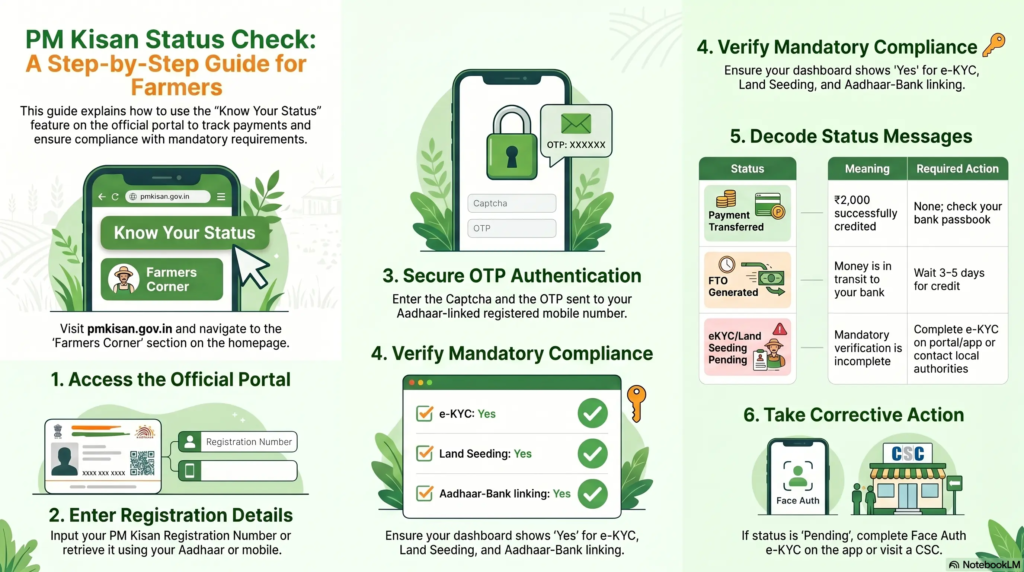
To verify your current standing and see if your funds have been processed via DBT, follow this 9-step guide on the official portal:
- Visit the official PM Kisan Samman Nidhi website at pmkisan.gov.in.
- On the homepage, navigate to the right-hand corner and click on “Know Your Status.”
- You will be redirected to the “Beneficiary Status” page; here, click the link “Know your registration number.”
- The system will present two options: “Search by Mobile Number” or “Search by Aadhaar Number.” Select the Aadhaar Number option.
- Enter your 12-digit Aadhaar number and the captcha code provided on the screen, then click “Get Mobile OTP.”
- Enter the OTP received on your Aadhaar-linked mobile number.
- After verification, your registration number will be displayed on the screen.
- Return to the main status page and enter this registration number along with the new captcha code.
- Click the “Get OTP” button to finally view your detailed PM Kisan status.
How to Retrieve Your Registration Number
If you have forgotten your registration ID, the portal allows for easy retrieval. You can use either your Aadhaar Number or the Mobile Number you provided during registration. By following the “Know Your Registration Number” workflow, you can ensure you always have the necessary credentials to check your payment history.
Mobile App and Digital Tools
For farmers needing on-the-ground assistance, digital tools are expanding. The Jan Dhan Darshak App is a supporting tool designed to help you locate the nearest Bank Mitras or Business Correspondents (BCs). If you find a “Payment Stopped” status on the portal, these local banking touchpoints are your first line of support for resolving data or banking issues.
HOW TO VIEW THE BENEFICIARY LIST
While the central government provides the funds via DBT, the identification of beneficiaries is a collaborative effort between the Centre and the States.
Farmer’s Corner Navigation
To see if your name is included in the current list for your village, follow these steps:
- Go to the ‘Farmers Corner’ section on pmkisan.gov.in.
- Click on the ‘Beneficiary List‘ button.
- Select your State, District, Sub-district, Block, and Village from the dropdown menus.
- Click on ‘Get Report‘.
- The portal will display the approved beneficiaries for that area.
State-Level Implementation
The responsibility for identifying landholder farmer families lies with the respective State Governments and Union Territory (UT) administrations. Local bodies ensure that the data provided to the Centre matches physical land records before the Direct Benefit Transfer is initiated.
REGISTRATION, ELIGIBILITY, AND DOCUMENTATION
To maintain the integrity of the scheme, the government adheres to strict standards for the 2026 cycle.
Who is Eligible?
The scheme is specifically for landholder farmer families, defined as a husband, wife, and minor children who own cultivable land.
- Urban Farmers: Eligible, provided they own cultivable land.
- Tenant Farmers: Explicitly excluded from the benefits of this scheme.
Required Documents
When registering on the PM Kisan portal, you must provide:
- A valid Aadhaar Card copy.
- Official Landholding documents.
- A copy of your Bank passbook (ensure the account is linked for DBT).
- A Citizenship certificate.
The Critical e-KYC Process
Completing the e-KYC is a mandatory requirement to receive funds in 2026.
- On the portal, select the ‘e-KYC‘ option.
- Enter your Aadhaar number and complete the OTP verification. This step confirms you are the active and rightful beneficiary, preventing your payments from being frozen during the “Fidelity Era” audits.
DATA QUALITY AND RECENT CLEAN-UP INITIATIVES
The transition to “data excellence” has led to significant changes in how the beneficiary list is managed.
The Cost of Inaccuracy
Data from NITI Aayog reveals that poor data quality can drain welfare budgets by an estimated 4% to 7% annually. To combat this, massive clean-up drives were undertaken. In FY 2024 alone, the deletion of 17.1 million ineligible names resulted in a saving of ₹90 billion. This ensures that funds are reserved exclusively for genuine farmers.
Rajasthan Case Study: Mission Utkarsh
The 161st SLBC meeting in Rajasthan highlighted “Mission Utkarsh,” an initiative under NITI Aayog. This mission specifically targets the 100 least performing blocks in the state for saturation. By digitising land records and improving data fidelity in these specific areas, authorities aim to bring them at par with the state average, ensuring that even the most remote farmers are accurately captured in the PM Kisan database.
COMPETITOR AND SCHEME COMPARISON
PM Kisan is part of a broader ecosystem of agricultural support in India.
| Scheme Name | Primary Benefit | Key Requirement | Target Audience |
| PM Kisan | ₹6,000 annual direct cash transfer | Land ownership (cultivable land) | Landholding farmer families |
| Kisan Credit Card (KCC) | Access to affordable short-term credit | Creditworthiness & farming activity | All farmers, including livestock |
| PM Fasal Bima Yojana | Crop insurance against calamities | Premium payment & crop-loss proof | Farmers growing notified crops |
COMMON CHALLENGES AND SOLUTIONS
Even in a robust digital system, minor errors can cause major disruptions.
IFSC/Bank Errors and the “Confirmation Tick” Trap
A common issue is the “two-digit transposition” error in bank codes. NITI Aayog cites the case of Lakshmi Devi, whose payment failed because her IFSC code was entered incorrectly.
The Lesson: Do not trust the “Confirmation Tick” alone. This tick often only means the field is filled, not that the data is correct. Always manually verify that your IFSC and account numbers are perfect during registration and e-KYC to avoid being caught in the treasury gateway’s rejection loop.
Grievance Redressal
If you find an error, use the “Report a mistake” option on the portal. This links citizen feedback directly with backend corrections. By acting as a “data steward” for your own record, you help we keep the system accurate and ensure your instalments arrive on time.
FREQUENTLY ASKED QUESTIONS (FAQs)
1. When was the 22nd instalment released, and what about 2026?
The 22nd instalment was released on 13 March 2026. For the 2026 cycle, instalments will follow the standard windows: April-July, August-November, and December-March. Check the portal regularly for specific dates.
2. Where can I check to see if my name is on the list?
Visit the “Beneficiaries List” under the ‘Farmer’s Corner’ at pmkisan.gov.in.
3. Who identifies the beneficiaries for PM Kisan?
While the Centre provides 100% funding and manages the DBT, the State Governments and UT administrations are responsible for identifying and verifying beneficiaries.
4. Can urban farmers apply?
Yes, urban farmers are eligible as long as they own cultivable land.
5. Are tenant farmers eligible?
No. The scheme is strictly for landholders; tenant farmers do not qualify for these benefits.
CONCLUSION AND CALL TO ACTION
As we progress through 2026, the PM Kisan scheme remains a vital lifeline. However, the move toward a “Fidelity Era” means the responsibility for receiving benefits is shared. Keeping your Aadhaar data updated, ensuring your bank details are flawless, and completing your mandatory e-KYC are the most important steps you can take.
Precision in data leads to trust in the system. We encourage you to visit the official portal today to check your status and verify your inclusion in the 2026 beneficiary list. Check your PM Kisan status today at pmkisan.gov.in to ensure your next ₹2,000 instalment arrives without delay.