Introduction: The Digital Heart of Telangana Real Estate
Welcome to the 2025-26 frontier of property administration. As a strategist navigating Telangana’s digital land pivot, I’ve watched the “Architecture of Transparency” evolve from a concept into a fiscal powerhouse. The IGRS Telangana (Integrated Grievance Redressal System) is the custodian of the state’s property history and its third-largest revenue earner, facilitating roughly ₹8,000 crore in transactions in the 2024 fiscal year alone.
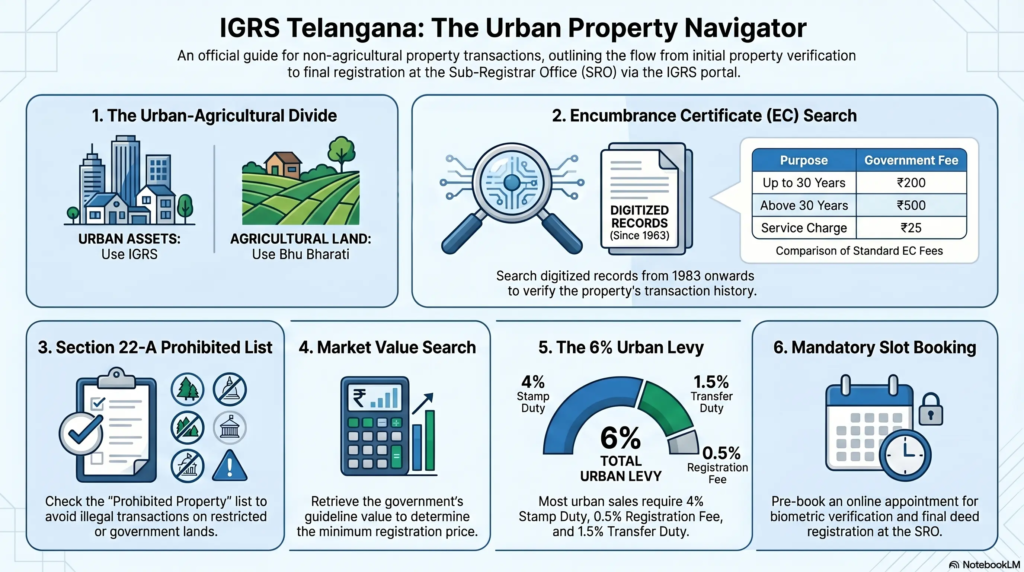
While the portal has significantly reduced administrative friction, the move toward a digitized, cloud-based infrastructure demands a higher level of technical due diligence from buyers. Whether you are eyeing a high-rise in Cyberabad or a residential plot in the peripheries, this guide serves as your strategic roadmap to securing your assets and avoiding the “paper traps” of the past.
The Dual Ecosystem: Decoding IGRS vs. Bhu Bharathi (Dharani Successor)
One of the first mistakes investors make is confusing urban records with agricultural ones. Telangana operates a functional split: IGRS is your “Urban Command Center,” while the Telangana Bhu Bharathi (Record of Rights in Land) Act, 2025 now governs agricultural assets.
Strategic Warning: If you hold agricultural land with incorrect entries, the Bhu Bharathi Act has established a strict one-year “use it or lose it” deadline. You must apply for corrections through the portal by April 14, 2025, or within one year of the entry being placed on the portal. Failing this window could freeze your ability to mutate or sell the asset indefinitely.
Feature Comparison: Urban vs. Rural Portals
| Feature Comparison | IGRS Telangana Portal | Bhu Bharathi Portal (Dharani Successor) |
| Primary Property Scope | Non-Agricultural (Urban/Commercial) | Agricultural (Rural/Farm Land) |
| Key Identifying Number | Document Number / House Number | 11-Digit Bhudhaar (Land Aadhaar) |
| Primary Documents | Sale Deed, Encumbrance Certificate | Pattadar Passbook, 1-B (ROR) |
| Core Functions | Registration, Duty Payment, EC Search | Mutation, Succession, ROR Correction |
| Administrative Control | Commissioner of Registration & Stamps | Local Tahsildars and RDOs |
Masterclass in Due Diligence: The Encumbrance Certificate (EC)
The Encumbrance Certificate is the most searched document for a reason: it is the only digital proof that a property is free from legal or financial liabilities like mortgages or court attachments.
- Form 15: A comprehensive list of every registered transaction for the search period.
- Form 16 (Nil EC): A certificate issued when no transactions are found, which is a prerequisite for most home loan approvals.
Strategic Insight on Timelines: Digital records on IGRS only date back to January 1, 1983. As a consultant, I always advise clients dealing with ancestral or long-held properties to conduct a manual search at the Sub-Registrar Office (SRO) for records predating this cutoff.
Two Modalities of Search:
- By Document Number: Requires the registration number, year, and SRO name.
- By Property Details: Allows search via District, Mandal, Village, and House/Flat Number.
Market Value & Circle Rates: Planning Your Finances
The government’s “Market Value Search” tool dictates your minimum registration costs. In February 2022, Telangana implemented a significant upward revision: 50% for agricultural land, 35% for open plots, and 25% for apartments.
To get a precise valuation, you must search down to the “Door Number” level on the portal. This ensures you are calculating stamp duty on the exact government-prescribed unit area rate for that specific building or locality.
Staying Safe with Section 22-A: Prohibited Properties
As a consultant, I’ve seen “dead-end” transactions freeze capital for years because buyers ignored Section 22-A. The SRO system is automatically hardcoded to block any registration attempt for properties on this list.
Prohibited categories include:
- Poramboke: State-owned lands.
- Endowment/Wakf: Religious or trust properties.
- Court-Ordered Stays: Lands under active litigation.
- Ceiling-Surplus: Lands acquired under land ceiling acts.
The Workflow: From Digital Portal to SRO Visit
The registration process is a hybrid model. You prepare the “Digital Shell” but execute the biometrics in person.
Phase 1: Digital Prep
- e-Challan & e-Stamps: Generate your 12-digit challan online. Note: e-Stamps have a 180-day validity period. If you do not register within this window, the challan must be revalidated or refunded.
- Slot Scarcity: In high-growth SROs like Rangareddy or Serilingampally, the system often limits daily slots to between 24 and 48. Book your slot as soon as your e-Challan is cleared.
Phase 2: Physical Execution
The Buyer, Seller, and two witnesses must attend.
- AI-Nibhrit & Privacy: The system now uses AI-Nibhrit to mask sensitive personal info on digital copies.
- Paperless Handover: Most modern SROs aim for same-day delivery of the registered deed via OTP-based verification for the handover.
Fiscal Obligations: 2025-26 Stamp Duty & Fee Schedules
| Transaction Type | Stamp Duty (%) | Transfer Duty (%) | Registration Fee (%) | Total Levy (%) |
| Sale (Urban Areas) | 5.50% | 1.50% | 0.50% | 7.50% |
| Sale (Gram Panchayat) | 5.50% | 0.00% | 2.00% | 7.50% |
| Gift (To Family) | 2.00% | 0.50% | 0.50% | 3.00% |
| Gift (To Non-Family) | 5.00% | 1.50% | 0.50% | 7.00% |
| Mortgage (No Possession) | 0.50% | 0.00% | 0.10% | 0.60% |
| Partition (Family) | 0.50% (Capped at ₹1L) | 0.00% | ₹2,000 (Fixed) | Variable |
Competitor Analysis: IGRS Portal vs. PropTech Intermediaries
PropTech blogs like Magicbricks and 99acres are excellent for educational walkthroughs, but they lack the legal finality of the official portal.
| Feature | Official IGRS Portal | Competitor Blogs (PropTech) |
| Accuracy | Absolute (Legal Authority) | Secondary (Informational Only) |
| Tone | Formal and Technical | Accessible and Conversational |
| Navigation | Module-based for transactions | Content-based for search/SEO |
| Value-Adds | Legally valid e-signed copies | “Tenant Assist” and premium search plans |
Legal Nuances: Handling Title Defects and “Chain of Title”
Clerical errors can haunt a property for decades. A common nightmare is the “Chain of Title” defect.
The Scenario: Imagine you bought House 7-35-156, but the deed mistakenly lists House 7-35-162/1 and its corresponding PTIN. If this error existed in the previous “link deed” (from the original owner to the seller), it is no longer a simple clerical fix.
Senior Advisor Warning: Rectification vs. Litigation If the error is deemed “substantial” by the SRO, they may suggest cancelling all prior deeds and re-registering from the original owner. If that original heir refuses to cooperate or demands additional money to sign, do not wait. File a civil suit for Declaration of Title to secure ownership through the court system.
The Future: Bhudhaar and Digital Mapping
Telangana is moving toward “Land Aadhaar.” The Bhudhaar is a permanent 11-digit unique ID for land parcels. When integrated with GIS mapping, this system aims to make boundary disputes nearly impossible by matching the digital survey map exactly with the physical ground reality.
Conclusion & Contact Information
Mastering the IGRS Telangana portal is no longer optional for the modern investor—it is the baseline for asset security. By understanding the 1983 record limits, the 2025 Bhu Bharathi deadlines, and the automatic blocks of Section 22-A, you move from a hopeful buyer to a strategic owner.
Official Helpdesk:
- Phone: +91 40-29313999 (10:00 AM to 5:00 PM)
- WhatsApp Support: 8247619983
Frequently Asked Questions (FAQs)
What is the “Golden Rule” for payment failures?
If your account is debited but no e-Challan is generated, wait 10 minutes. Do not attempt a second payment. The system typically reconciles within this window.
Why can’t I find records before 1983?
Digitization in Telangana only covers records from January 1, 1983. For older properties, you must apply for a manual search at the respective SRO.
What is the processing time for a digital EC?
An online EC usually takes 2 to 6 working days. However, if a manual search is triggered due to the age of the property, it can take up to 30 days.
Can NRIs register properties through IGRS?
Yes. NRIs can access all informational services online. For registration, they can execute a GPA (General Power of Attorney) to an authorized representative in India.