In the high-stakes world of Telangana real estate, the Encumbrance Certificate Telangana (EC) is the single most critical document for establishing the “genuineness” of a property. As a senior legal consultant, I often tell clients that while the Pattadar Passbook shows who claims to own the land, the EC reveals the property’s “legal DNA”—every registered transaction, mortgage, and court attachment that has occurred over decades.
Under the Indian Evidence Act 1872, the EC serves as a public document with significant legal weight, acting as admissible proof of registered transactions. However, as we navigate the landscape of 2026, the systems for obtaining this document have undergone a radical transformation. With the implementation of the Telangana Bhu Bharati (Record of Rights in Land) Act, 2025, the state has moved toward a more secure, government-controlled digital infrastructure. Whether you are a buyer performing due diligence or a landowner applying for a crop loan, understanding the nuances of the EC Telangana search is mandatory for a secure transaction.
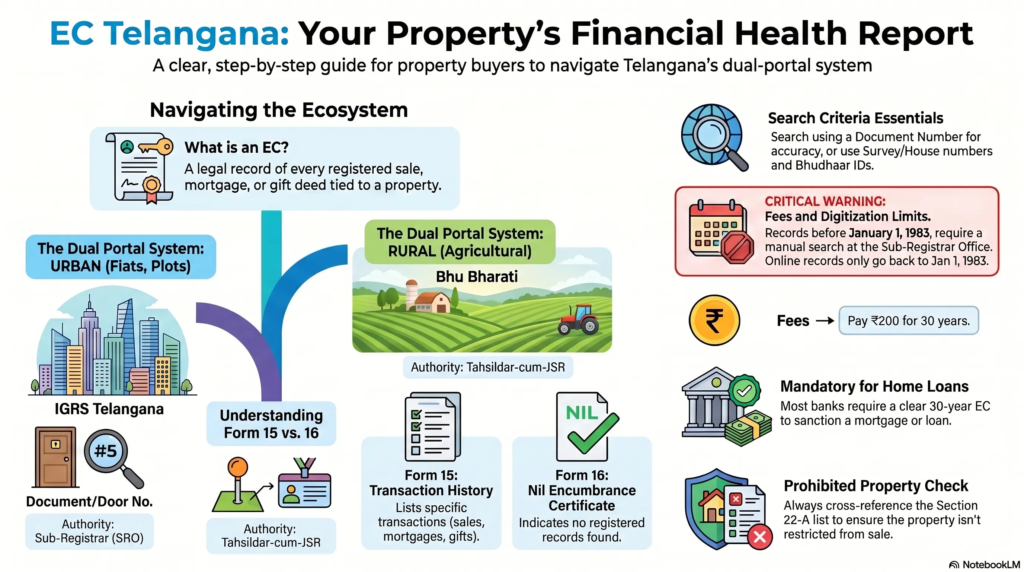
The Dual Portal System: Bhu Bharati vs. IGRS Telangana
Navigating property records in Telangana requires a clear understanding of the state’s bifurcated digital system. Following the 2025 reforms, agricultural and non-agricultural (urban) records are managed through separate gateways.
Portal Selection Guide
| Property Category | Primary Portal | Record Coverage | Search Method |
| Agricultural Land | Bhu Bharati | Post-2025 (Integrated Dharani records) | 11-digit Bhudhaar / Survey Number |
| Urban Plots, Flats, Commercial | IGRS Telangana | Digitized from 01/01/1983 onwards | Document Number / Property Details |
| Historical/Ancestral (Pre-1983) | Manual SRO Ledger | Full history since SRO inception | In-person SRO Search |
The NALA-Conversion Exception: A common pitfall for buyers involves land converted from agricultural to non-agricultural use (NALA). For these properties, the transaction history is split: records prior to the conversion date will reside in the Bhu Bharati EC database, while all subsequent transactions (post-conversion) will be found via the IGRS Telangana EC search. A comprehensive title search for a converted plot must involve both portals to ensure there are no “hidden” mortgages from the land’s agricultural past.
Decoding EC Types: Form 15 vs. Form 16 (Nil EC)
When you perform an Encumbrance Certificate Telangana search, the department will issue one of two forms. Understanding the legal difference is vital for risk assessment.
- Form 15: This is issued when the search period reveals one or more registered transactions. It provides a chronological log of sale deeds, gift deeds, mortgages, and release deeds.
- Form 16 (Nil EC): This is issued when no registered transactions are found for the requested period.
Buyer’s Caution: A “Nil EC” is frequently misinterpreted as a “clean title.” In reality, a Nil EC only confirms that no registered transactions exist in the digital database for those specific years. It does not account for:
- Unregistered oral agreements or possession transfers.
- Transactions occurring before 1983 that were never digitized.
- Claims by legal heirs in ancestral properties that have not been through a formal “Succession Application.”
The 2025 Evolution: Bhu Bharati and the Replacement of Dharani
The introduction of the Bhu Bharati portal in April 2025 was not merely a cosmetic update; it was a legislative necessity to resolve the systemic failures of the previous Dharani system. By December 2023, the Dharani portal had accumulated over 6.46 lakh pending grievances, leaving thousands of landowners in legal limbo.
Why Bhu Bharati Replaced Dharani
The Dharani system suffered from significant data mismatches and security concerns. Most notably, the portal was outsourced to a private entity (TerraCIS Technologies), which raised alarms regarding the security of sensitive land data. In contrast, Bhu Bharati was developed in-house by the National Informatics Centre (NIC), ensuring that land records remain under strict government control and align with the national Digital India initiative.
Key Innovations and MRO Empowerment
Under the Bhu Bharati Act, the government conducted extensive Revenue Sadassus (public forums) to process nearly 8.5 lakh applications that were stalled. A major shift in 2026 is the empowerment of the Mandal Revenue Officer (MRO). Unlike the centralized Dharani model, Bhu Bharati allows MROs to conduct on-site village visits and field verifications to resolve disputes locally.
One of the most legally significant changes is the restoration of the “Enjoyment Column.” This column now explicitly lists the actual occupants of the land, providing a crucial layer of transparency for buyers to distinguish between the “Pattadar” (title holder) and the person in physical possession. Furthermore, the system now fully supports joint ownership, allowing multiple co-owners to be listed with their specific share percentages—a feature that was notoriously absent in the Dharani era.
The Bhudhaar and GPS Mapping System
Bhu Bharati introduces Bhudhaar, a unique identification number for land parcels. While aligned with the 14-digit National ULPIN, the Telangana search interface typically utilizes an 11-digit Bhudhaar number.
- GPS Accuracy: Every land parcel is now mapped with GPS coordinates, creating a digital “boundary polygon” that prevents encroachment.
- The “99” Prefix Warning: If your Bhudhaar number begins with “99”, the land is currently in a temporary geo-referencing stage. This indicates that the EC data might be incomplete or the boundaries are pending final verification. I advise clients to treat “99” prefix properties with extreme caution until they transition to a permanent status.
IGRS Telangana EC Search: Step-by-Step Guide for Urban Properties
For apartments in Hyderabad, commercial spaces, or residential plots, the IGRS portal is your primary tool.
- Access the Portal: Visit
registration.telangana.gov.in. - User Registration: You must create an account using a valid mobile number.
- Encumbrance Search: Select “Encumbrance Search (EC)” from the Online Services menu.
- Disclaimers: Read the information regarding the 1983 digital limit and click “Submit.”
- Search Criteria:
- Search by Document Number: This is the most accurate method. Enter the document number, year of registration, and select the correct SRO from the dropdown.
- Search by Property Details: If you don’t have the document number, enter the District, Mandal, Village, and Survey Number/House Number.
- Search Period: Select your years. While 13 years is the legal minimum for many transactions, I recommend a 30-year search for high-value properties.
- Download: Once the results appear, you can view the statement for free or pay the required fee to download a certified copy.
6. Bhu Bharati EC for Agricultural Land: Step-by-Step Guide
The Bhu Bharati EC process is specifically designed for agricultural land and is optimized for speed.
- Visit the Website: Navigate to
bhubharati.telangana.gov.in. - Land Details Search: Go to Information Services → Land Details Search.
- Specific Input: Select your District, Mandal, and Village.
- Survey Number Warning: You must enter the exact Survey Number and Sub-Division. For example, entering “142” when the parcel is “142/A” will result in a “No Record Found” error or the parent record only.
- Bhudhaar Search: If you have the 11-digit Bhudhaar, use it. It is the fastest method and bypasses sub-division complexities.
- Obtaining the Certified Copy:
- Login via OTP.
- Navigate to the “EC Download” section.
- Pay the nominal fee (₹20 to ₹200 depending on the search duration).
- Download the digitally signed PDF. This document is legally equivalent to a physical copy and is accepted by all major banks (SBI, HDFC, ICICI) for crop loans and mortgages.
Fees, Timelines, and Validity
| Service Mode | Cost (Approximate) | Processing Time |
| Online Viewing | ₹50 per year of search | Instant |
| Certified Digital Download | ₹20 – ₹200 (Period dependent) | 1–2 Days |
| Offline (SRO/MeeSeva) | ₹500 (30+ years) + Service Fees | 15–30 Days |
Validity: An Encumbrance Certificate Telangana is generally considered valid for 6 months from the date of issuance for the purpose of bank loans, mutation, and registration. Because property status can change “day in and day out,” always pull a fresh EC right before a final transaction.
Critical Limitations and Prohibited Properties
As a legal consultant, I must emphasize that digital searches have boundaries.
- The 1983 Digital Record Limit: Online records for both Bhu Bharati and IGRS generally begin on January 1, 1983. If you are dealing with ancestral property or land held by a family for generations, a digital “Nil EC” is insufficient. You must visit the SRO for a manual search of the “age-old” ledgers.
- Section 22-A (Prohibited Properties): This is the “blacklist” of Telangana real estate. Properties marked under Section 22-A are restricted due to government ownership, endowment (temple) land, or forest classification. Always check the “Prohibited Properties” tab on the portal.
- Forensic Audit and Part-B Status: During the Dharani transition, many properties were moved to “Part-B” status following a Forensic Audit of land records. If your survey number returns no result or a “disputed” flag, it likely requires an MRO verification to resolve a mismatch between old records and current GPS surveys.
How to Read and Verify Your EC: Red Flags for Buyers
Obtaining the Encumbrance Certificate Telangana is only half the battle; interpreting it requires a keen legal eye.
- The Chain of Ownership: Ensure there are no gaps. If Owner A sells to Owner B, and then Owner D sells to Owner E, where is the record for Owner C? Gaps often hide unregistered successions or fraudulent transfers.
- Missing Discharge Deeds: This is the most common red flag. If the EC shows a mortgage entry from 2015, but no corresponding “Discharge Deed” or “Release Deed” from the bank, that property is legally encumbered. A bank’s “No Due Certificate” letter is legally insufficient for a property transfer; the discharge must be registered at the SRO to reflect on the EC.
- Court Attachments: Entries labeled “Court Attachment” mean the property is frozen by judicial order. Do not proceed with any payment until you have a certified “Vacation Order” from the same court.
- Multiple Quick Sales: If a property has changed hands three or four times in a single year, it is often a sign of a “hot potato” title—where owners are quickly offloading a property with known legal defects.
Conclusion: Ensuring a Safe Transaction in Telangana
The EC Telangana is your primary shield against fraud. It is legally mandatory in five critical scenarios:
- Sale/Purchase: To prove a clear, marketable title.
- Bank Loans: Required for all mortgage, housing, and crop loans.
- Mutation: The MRO will not update ownership records without verifying the transaction history.
- Succession: Under Section 7 of the Bhu Bharati Act, 2025, legal heirs must submit an EC to prove the property is free of debt before inheritance is processed.
- Legal Evidence: It is the “Gold Standard” of documentary evidence in ownership and boundary disputes.
Pro-Tip: Always request a 30-year EC. While 13 years is common, 30 years is the standard for banks and provides the most comprehensive protection against ancestral claims.
Official Support: For technical issues or grievance tracking:
- Bhu Bharati Helpline: +91 40-29313999
- IGRS Toll-Free: 1800-599-4788
- Support Email: support@bhubharati.telangana.gov.in
By utilizing the Bhu Bharati EC and IGRS portals for thorough due diligence, you ensure that your property investment in Telangana is built on a foundation of legal certainty.