The agricultural policy framework in Telangana has entered a new era of targeted intervention with the Rythu Bharosa scheme. Officially launched on January 26, 2025, this initiative represents a structural overhaul aimed at rectifying systemic inefficiencies, ensuring fiscal sustainability, and prioritizing active cultivators. If you are looking to understand the new guidelines, track your direct benefit transfers, or learn how to apply, this guide covers everything you need to know about the 2026 rollout.
What is the Telangana Rythu Bharosa Scheme?
The Telangana agriculture investment support program is designed to provide upfront capital to farmers before the commencement of the Kharif and Rabi cropping seasons. The core philosophy is to enable farmers to purchase essential inputs like seeds and fertilizers without resorting to exploitative informal credit, which historically carried interest rates of 24% to 36%.
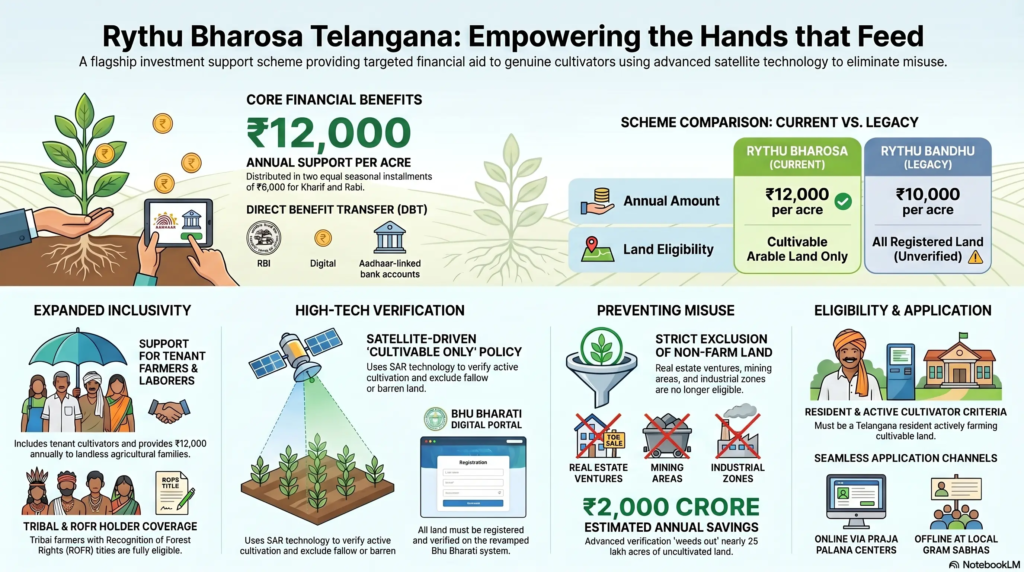
Under the revamped scheme, the government provides an annual grant of ₹12,000 per acre. This is distributed via Direct Benefit Transfer (DBT) in two equal seasonal tranches of ₹6,000.
Rythu Bharosa vs. Rythu Bandhu: Key Changes
When comparing Rythu Bharosa vs Rythu Bandhu, the most critical shift is the move toward strict outcome-oriented welfare. The legacy Rythu Bandhu model provided ₹10,000 per acre but suffered from a regressive distribution system that paid out on unverified registered land. The new Rythu Bharosa model limits payouts strictly to “active cultivable arable land,” integrating satellite verification and actively including historically marginalized tenant farmers.
2026 Rythu Bharosa Eligibility Criteria
To qualify for Rythu Bharosa eligibility 2026, applicants must be permanent residents of Telangana with agricultural land actively used for farming. Beneficiaries must be registered Pattadars or hold Recognition of Forest Rights (ROFR) pattas, and their land must be verified on the state’s Bhu Bharati portal.
Support for Tenant Farmers and Landless Laborers
A major departure from the previous regime is the active inclusion of tenant cultivators. The Rythu Bharosa Tenant Farmer Eligibility rules state that tenant farmers with a registered lease deed qualify for the ₹12,000 per acre annual support.
Additionally, landless agricultural families who depend on farm labor are supported through the Indiramma Atmiya Bharosa sub-scheme. Eligibility is determined through MGNREGS job card data; a family qualifies for ₹12,000 annually if at least one member worked a minimum of 20 days in the 2023–24 financial year.
Strict Exclusions: Why Non-Arable Lands Don’t Qualify
To ensure public funds reach genuine farmers, the government has implemented a strict cultivable land only policy. Under the previous administration, an estimated ₹25,672 crore to ₹30,000 crore was disbursed to non-agricultural lands.
To prevent this, the following land categories are strictly excluded:
- Real estate layouts, villas, and ventures.
- Mining lands, stone crushers, and industrial zones.
- Institutional lands, warehouses, and function halls.
- Infrastructure projects like highways and canals.
Rythu Bharosa 2026 Payment Schedule
The Rythu Bharosa Next Installment Date for the 2026 Rabi (Yasangi) season introduces a strategic shift in how funds are distributed. In the past, staggered systems often forced mid-sized landholders to wait months for their assistance.
The New “First-Acre Priority” Disbursement
To mitigate administrative bottlenecks and provide immediate liquidity to the most vulnerable, the state introduced a “first-acre priority” payout method for 2026.
Phase 1: March 22 Payout Details
The rollout officially began on March 22, 2026, in Narmetta village, Siddipet district. In this initial phase, a tranche of ₹3,590 crore was released, simultaneously crediting ₹6,000 (the first acre’s value) to every single one of the 70 lakh eligible farmers, regardless of their total landholding size.
This was followed by a second phase in mid-April for farmers with mid-sized holdings (one to two acres), and a final tranche in late April to cover the remaining acreage for larger landholders.
How to Do a Rythu Bharosa Status Check
Farmers tracking their disbursements can perform a Rythu Bharosa Status Check by visiting the official portal at rythubharosa.telangana.gov.in. Payments are processed via the RBI’s DBT system directly into the beneficiary’s bank account.
Using the Bhu Bharati Portal and Aadhaar Linking
The backbone of the new verification process is the Bhu Bharati Land Records system, replacing the legacy Dharani portal. The state utilizes a triad verification workflow (L1, L2, L3).
- L1 & L2: Agriculture Extension Officers (AEOs) and town planning staff verify land use, heavily supported by monthly satellite mapping (SAR technology) to ensure the land isn’t fallow or converted to real estate.
- L3: The District Collector grants final approval.
For a successful transfer, a Pattadar Passbook Aadhaar Link is mandatory. If a farmer’s bank account is not Aadhaar-seeded (eKYC incomplete), the payment will be stalled in the pipeline. Farmers with discrepancies in their land classification must raise a grievance through the Bhu Bharati portal or request a joint physical survey.